
Many B2B companies distribute their resources evenly across all business units, regardless of their market potential and competitive position. The result: profitable growth markets remain underfunded, while stagnant product lines unnecessarily tie up capital and management capacity. Portfolio analysis breaks this pattern. A portfolio matrix systematically evaluates which business units deserve investment and which should free up resources. This evaluation is based on hard market data and competitive metrics, not on gut feeling or political compromises.
Matrix models such as the BCG matrix or the McKinsey portfolio visualize the strategic position of each business unit and provide clear recommendations for investment and divestment decisions.
One point that is often overlooked in practice is that every model is only as good as the data it is fed with. Therefore, especially in B2B markets, where reliable information on products and services, market shares, or competitive situations is not easy to obtain, the systematic analysis of markets and competitors plays a central role.
This guide explains how to properly use portfolio analysis tools such as the BCG matrix (four-field matrix), populate them with reliable data, and set strategic priorities.
What is a portfolio analysis?

Key principle: Not all business units deserve the same attention. High-growth areas with a strong market position require different strategies than stagnant business units with a weak competitive position. Portfolio analysis visualizes these differences using matrix models – typically with two dimensions, represented as a quadrant diagram (four-field matrix).
Practical applications of portfolio analysis:
- Product portfolio: Which product lines should be expanded, and which should be discontinued?
- Market portfolio: Which geographic markets or customer segments should be invested in?
- Technology portfolio: Which manufacturing or IT technologies should be further developed?
The result: An objective basis for decisions regarding budget allocation, resource management and strategic direction, based on market data instead of opinions.
The BCG Matrix: The most important tool
The BCG matrix is one of the most widely used portfolio analysis tools worldwide and reduces strategic complexity to two crucial dimensions. Its strength lies in its simple visualization and clear logic for action.
Matrix structure

X-axis: The relative mark
Market share is the competitive strength expressed as the ratio of a company's own revenue to that of its strongest competitor. A value above 1.0 indicates market leadership, while a value below 1.0 signifies a follower position. This metric correlates strongly with cost advantages due to economies of scale and profitability.
Y-axis: Market growth indicates the attractiveness of the market through its percentage growth rate. High growth rates signal expanding markets with potential, while low rates suggest saturated or shrinking markets. The threshold is typically 10% annual growth, but should be adjusted for each industry.
The four fields / categories of the portfolio matrix
Four strategic quadrants: The intersection of both dimensions creates four quadrants, each representing different market-competitive constellations. Each quadrant implies a specific standard strategy for investment, divestment, or harvesting. The size of the circles in the matrix further visualizes the sales volume or strategic importance of each business unit. This makes it immediately clear which areas are tying up the most resources.
Question Marks – High-Risk Investment Candidates
Characteristics: High market growth, low relative market share
Question Marks operate in attractive growth markets without a dominant position. They consume cash instead of generating it. Building market share against established competitors requires continuous investment without any guarantee of success.
Strategic options: Invest selectively to develop into stars, or exit early. Decision criterion: Does the company possess the technological and financial strength to challenge market leaders?
B2B example: AI-powered quality assurance software for automotive suppliers. The market is growing 25% annually, with an 8% market share. Established MES providers dominate with integrated solutions. Decision: Invest heavily in sales or sell to a larger player.
Rising Stars – Future of the Company
Characteristics: High market growth, high relative market share
Market leaders in expanding markets. Profits are reinvested directly into growth financing and defending their leading position, typically resulting in cash flow neutral to negative, as high investments required to defend market leadership often exceed profits. Stars later become cash cows when market growth slows.
Strategic option: Invest consistently, extend the lead, consolidate market leadership.
B2B example: Robotic cells for battery assembly in e-mobility. 35% market share, 40% market growth. Despite high profitability, profits are being reinvested in R&D and capacity expansion – competitors such as ABB and KUKA are investing aggressively.
Cash Cows – Silent Profit Generators
Characteristics: Low market growth, high relative market share
Established market leaders in saturated markets. Their dominant position allows for high margins with low marketing costs. Cash cows generate more cash than they need. They finance question marks and stars.
Strategic option: Harvest profits, invest minimally. Only make maintenance investments to secure the position. Cash flow generated by cash cows finances growth areas.
B2B example: Conventional CNC lathes, 45% market share, 2% market growth. Technically mature, minimal development costs, 18% EBIT margin. Finances the development of new laser welding systems.
Poor Dogs – Resource Traps
Characteristics: Low market growth, low relative market share
Weak position in unattractive markets. Poor dogs tie up management capacity and resources without profits or prospects. They are often held for emotional reasons or perceived strategic importance.
Strategic option: Divestment, sale, or liquidation of the poor dogs. Exception: Strategic importance as a full-service provider component, then minimal resource commitment with maximum cash flow extraction.
B2B example: Pneumatic controls, market shrinking 5% annually, 12% market share, 4% EBIT margin. Ties up expensive specialists for maintenance. Solution: Sell to niche providers, shift resources to IoT control technology.
For further details on the operational calculation of relative market share and market growth, we refer to the numerous publications on the subject.
McKinsey Portfolio Analysis – 9-Field Matrix as an Alternative
Brief description of portfolio analysis according to the McKinsey model
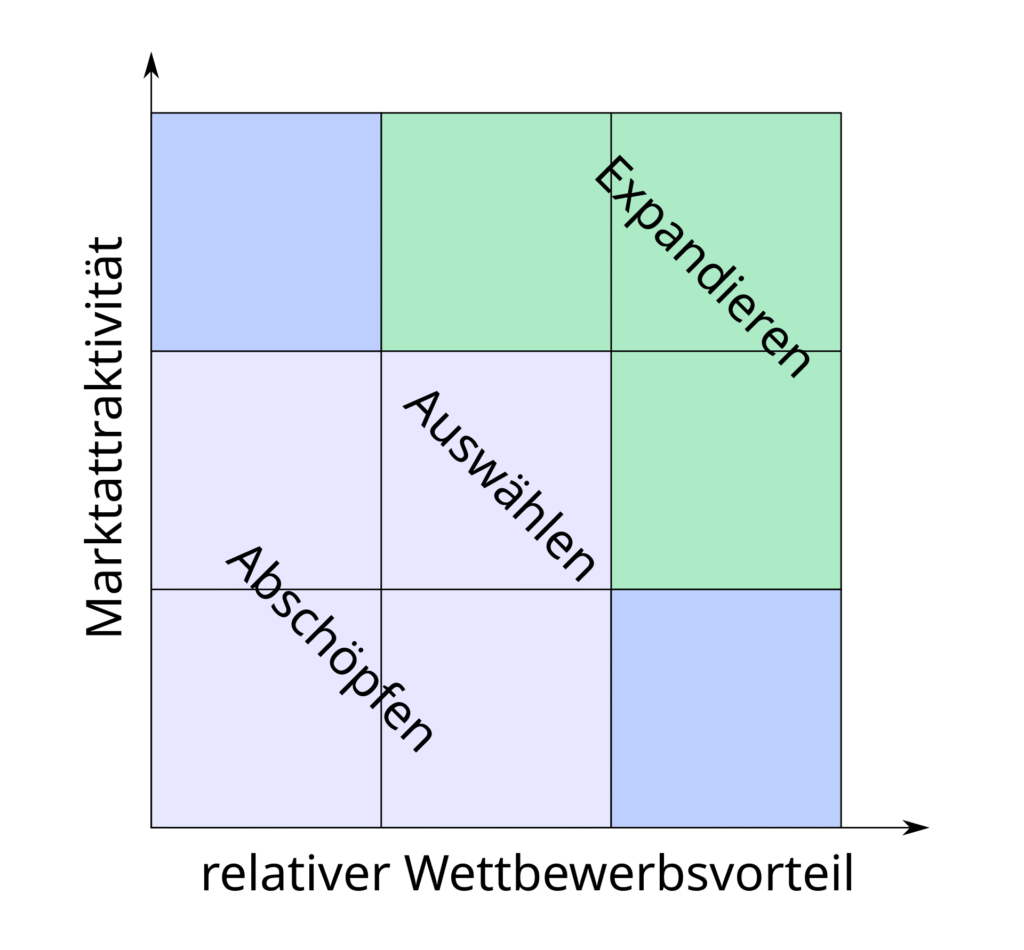 Naturally, strategy consultancies have also developed a model for portfolio analysis, which proposes an evaluation of business units, products, or services based on a 9-quadrant matrix. The principle is quite similar to the BCG matrix (or Boston matrix), although the structure is somewhat more flexible, but in any case, also more complex. The X-axis represents the competitive strength of the company/product, and the Y-axis represents its market attractiveness.
The model leaves relatively open which operational metrics are used to assess market attractiveness or competitive strength; in any case, weighted scoring of several factors is possible. For example, market size and growth, profitability, and the competitive intensity of the industry can be used in a weighted scoring system for market attractiveness . For competitive strength, McKinsey suggests, for example, a weighted assessment of market share, product quality, cost position, or customer relationships.
When is which model suitable?
The choice of portfolio analysis model depends largely on the research objective, the required level of detail, and the available data. The Boston Consulting Group (BCG) model is certainly suitable for generating a quick overview and easily interpretable results. McKinsey's portfolio analysis, on the other hand, is better suited to complex markets and analyses involving more nuanced influencing factors.
Conducting portfolio analysis – 3 steps to success
Step 1: Clearly define and delineate business units
The basis of any portfolio analysis is the clear delimitation of the units to be evaluated according to products, markets, or regions. Especially in B2B markets, it is advisable to orient oneself towards market-standard segmentation criteria, as this generally makes data collection on companies, market share, growth potential, or other evaluation categories easier.
Step 2: Collect data in a structured way
To reliably populate the model with data, collecting relevant information on sales, margins, market volume, competitors, growth rates, etc., is the crucial success factor in portfolio analysis. Even the most complex model is worthless if the underlying data is unreliable. Especially in B2B markets, a balanced research methodology and the use of a wide range of data sources are essential. Professional service providers and market analysis agencies can provide support here with their research expertise and comprehensive access to sources.
Step 3: Create matrix & derive strategies
Once the portfolio analysis has been successfully populated with the necessary data, the next step is to position the business units or product areas and derive implications and strategies for corporate management, product development, marketing, and sales. This allows for targeted investment priorities and the alignment of the company with future growth markets and new opportunities.
Where does the support of specialized market analysis agencies make sense for portfolio analysis?
Whether portfolio analyses are created using only in-house resources or with the support of specialized external consultants depends on the scope, complexity, and available resources within the company. Some advantages of collaborating with an external specialist are described below:
Sound market data
Specialized research firms have extensive access to sources and databases. Knowing the appropriate data sources allows market research professionals to deliver reliable data for portfolio analysis. The added value lies in a data-driven foundation instead of results based on gut feeling or estimates.
Methodological expertise
Experienced agencies advise on selecting the appropriate model and help to make industry- and company-specific adjustments. Based on best practices and experience from comparable projects, a solid foundation for the success of the portfolio analysis can thus be laid.
Objective external perspective
External analysts, compared to internal resources, can provide an unbiased assessment of key criteria such as market growth, market share, and competitiveness, thus supporting the goal of creating a neutral and reliable analysis. Established perspectives and assumptions can be questioned, and blind spots in previous market and competitive analyses can be specifically identified.
Avoid common mistakes in portfolio analysis
Several common mistakes are repeatedly made when conducting portfolio analyses. These should be avoided in order to create the most reliable and helpful analysis possible for the company:
Common methodological pitfalls – market definition and sources
Typical methodological pitfalls include incorrect market definition or unsuitable segmentation of markets, products, and portfolios. This can make it very difficult to research usable market data right from the start.
Furthermore, insufficient research and reliance solely on internal, existing data play a significant role in misjudging business areas, product groups, or entire divisions. However, external sources can also be unreliable – the internet is full of market studies and statistics where the methodology and sources are not clearly traceable and are therefore unsuitable for a sound portfolio analysis.
Strategic errors – emotions and opinions instead of neutral facts
In practice, misguided decisions often arise due to emotional attachment to traditional business areas, products, or technologies. In these cases, portfolio analysis is merely used to reinforce pre-existing decisions with seemingly reliable data.
Conclusion: When is professional portfolio analysis worthwhile?
 A professional portfolio analysis is particularly worthwhile when a company operates in diverse markets or product/service sectors, or maintains a broad technology portfolio. In these cases, portfolio analysis can be a valuable tool for strategic corporate management and support fact-based decisions.
Utilizing external support, particularly in obtaining the necessary data on the market, competition, market share, growth potential, opportunities, and risks, is especially worthwhile in markets where market data is difficult to access. An objective external perspective and the expertise of a specialist in portfolio analysis, market analysis , and competitive analysis be beneficial when internal resources are limited, internal discussions are stalled, or there is a desire for greater methodological depth.
Are you looking for an experienced partner for your portfolio analysis in the B2B and industrial sectors?
MEYER INDUSTRY RESEARCH has specialized for over 15 years in customized market, competitive, and technology analysis, as well as commercial due diligence in the B2B sector. Our clients use our data for portfolio analysis, strategy development, and the targeted, fact-based advancement of innovations, product groups, and business units. We would be pleased to discuss your specific requirements with you.
Sources:
https://www.bcg.com/about/overview/our-history/growth-share-matrix
https://www.controllingportal.de/Fachinfo/Grundlagen/Portfolio-Analyse-Neun-Felder-Matrix-.html

