
Strategies for successful market entry
Developing new markets and launching new products is a crucial component of strategic corporate management. However, the success of a go-to-market strategy depends significantly on a systematic approach, the necessary market knowledge, and a structured market entry plan. This overview article examines the key factors for entering a new market and what companies need to consider when launching a new product or service.
Regardless of whether you are planning a market entry with a new product, a new service, or into a new country/abroad – here you will find current tips and know-how for the successful preparation of your market entry.

Where do German companies stand in terms of market entry for new products and services?
According to a recent survey by the ZEW Mannheim, the share of revenue generated by innovations in German companies has recently been around 12% of total revenue. An innovation is defined as a product or service that has been newly introduced or significantly modified within the last three years.
Ten years ago, the revenue share was still over 15%. Leading countries in innovation, such as Switzerland, Sweden, and the USA, regularly show significantly higher figures. This is an alarming development, as new products and services help to meet rapidly changing customer needs and implement the latest technologies and innovations. For companies that want to succeed in demanding markets and strategically drive their expansion, go-to-market strategies for entering the market with a new product or service play a crucial role.
What is meant by a go-to-market strategy?
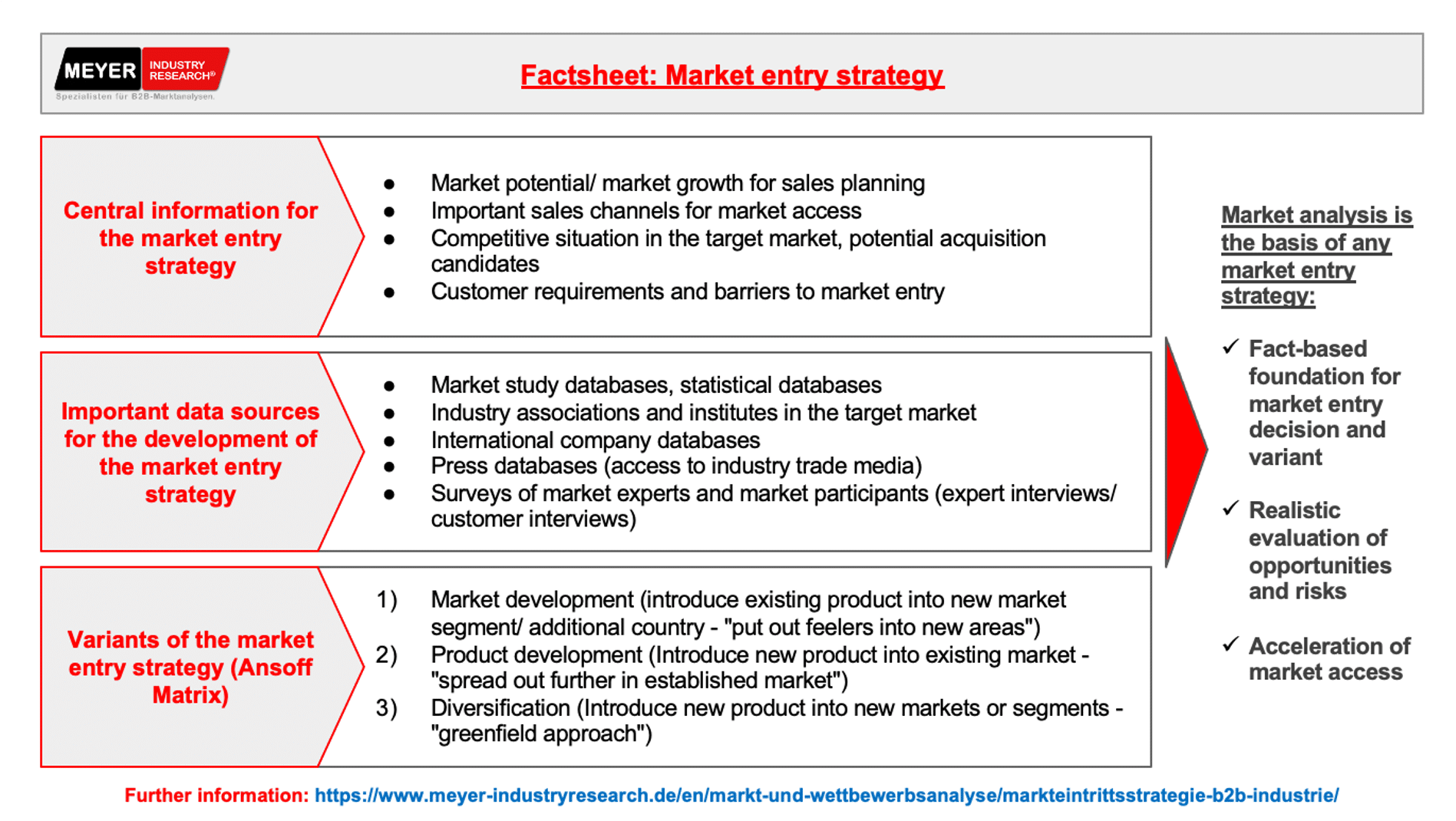
A market entry strategy, by its usual definition, determines the path a company intends to take to enter a new market. The most common market entry strategies are accessing the new market through its own resources (e.g., establishing a separate subsidiary), market entry via exports from an existing local subsidiary (often in cooperation with local sales partners or distributors), joint ventures/investments (cooperation with a local company as a form of market entry), or the acquisition of a start-up or an already established supplier for rapid market entry (M&A).
What role does systematic market analysis play in the go-to-market strategy?
To determine the appropriate market entry strategy, a market entry analysis conducted. This analysis serves to reliably assess the strengths, weaknesses, opportunities, and threats of the company for the planned market entry (SWOT analysis including consideration of market entry barriers) and can also be used to identify potential cooperation partners or M&A targets .
The foundation of a successful market entry strategy is a thorough examination of the relevant market using professional market research methods. This allows for the development of robust strategies and a concrete market entry plan. The most important market research methods include both secondary research (e.g., statistics, databases, company publications in the market, trade articles) and primary methods (e.g., expert interviews, customer surveys, panels). Many companies also utilize the services of an external market analysisspecialist who can provide experience and specialized resources to support their expansion into the new market.

What information is needed for a go-to-market strategy?
Every market entry strategy requires a robust preliminary analysis to realistically assess the opportunities and risks in the new market and to facilitate and accelerate the company's entry. A systematic market entry strategy is based on a solid understanding of market potential (market size, market segments, market growth), the competitive landscape (market participants, startups, M&A opportunities), customer requirements (key target customers/customer groups and their needs, distribution channels) , as well as trends and regulations (e.g., legal requirements, technological trends) in the target market. Based on this information, a sound decision can be made as to whether developing the market with internal resources, through a partnership, or via an M&A strategy offers the most efficient market access. The individual components in detail:
1. Market size / Market potential
Assessing market potential is a key factor in all market entry strategies. Market potential analysis sales and/or revenue figures for the relevant product or the entire target market, usually over the past few years. This allows for initial insights into the potential revenue of the company itself and helps determine which investments are worthwhile given the expected market revenue. Typical market size metrics used in market entry strategies include:
- Actual realized market revenue (e.g. in billion EUR/billion USD)
- Actual number of units sold in the market (depending on the target market, e.g., number of units sold)
- Historical market growth (expressed, for example, in the form of a CAGR – Compound Annual Growth Rate)
- Market potential (especially for new markets/products/innovations – theoretically achievable volume in a market)
2. Market Growth/Forecast
Market forecasting is particularly interesting for companies developing market entry strategies. It involves assessing how the market is likely to develop in the coming years and how the company can best benefit from this development. Key questions in this context include:
- What growth potential can be expected in the new market within the overall market in the coming years?
- Which product, technology, and services are growing the fastest and are expected to show the best development in terms of key indicators such as revenue, profit/profitability, and market share?
- Which foreign target country offers the most attractive growth potential in the entire market?
3. Market segments
To gain a detailed understanding of the potential, market segmentation or subdivision is essential for any market entry strategy. Segmentation can be based on various criteria; common examples include:
- Product features/technical segmentation
- Target groups/industries
- Price segments
- regional criteria
Based on the analysis of the market segments, it is possible to assess in which areas entry into the new market is particularly attractive, where resources should be focused in the new market, and where marketing and sales should place particular emphasis.
4. Competitive situation
A key question regarding market entry strategies is the assessment of the competitive landscape. Essential aspects to consider in a competitive analysis include, for example:
- Which competitors are currently active in the market?
- What market share do they have in the target market?
- What financial indicators (revenue, profit) are the competitors achieving in the target market?
- What strategies does the competition use to approach the market, and what are its strengths and weaknesses?
- Which product segments do they serve under which brand in the target market?
- How is the competition organized (e.g., separate organization or joint venture)?
- What measures are the competitors taking to reach their customer groups?
- What resources does the competition have and how do competing companies approach the market?
- Which companies (start-ups or established companies) would be interesting for an acquisition?
5. Target customers
In addition to analyzing market size and competition, the customer landscape also plays a crucial role in market entry strategies. Key questions when analyzing target customers include, for example:
- Who are the most important customer companies in the industry?
- How concentrated is the customer landscape (many small providers or a few large companies in the target market, customer market share?)
- What strategies and skills can be used to develop key accounts?
6. Customer requirements
The term "customer requirements" encompasses numerous questions that can be examined within the framework of a market entry strategy:
- What key success factors and requirements must be met to tap into the new customer sector/market?
- Are there market entry barriers that make market access difficult domestically or abroad (e.g., regulatory market entry barriers such as standards and certificates/approvals, or de facto market entry barriers such as strong customer relationships between suppliers and customer companies)?
7. Distribution structure
To be successful in the new market, establishing the right sales strategies plays a crucial role. Among other things, the following need to be clarified:
- What distribution structure exists in the market and is best suited for the optimal placement of the product?
- With which distribution partners could the market entry be implemented, the brand established in the new market, or the business expanded?
- Which companies might be suitable partners, for example through a joint venture, acquisition, or licensing agreement?
8. Trends
Finally, considering medium- to long-term trends plays an important role in all types of market entry strategies. This includes, for example, analyzing the following questions:
- What trends are driving companies (competitors, customers, suppliers) in the medium to long term and should therefore be considered for a successful market entry?
- Are there any innovative start-up companies in the area that are advancing new technologies and thus changing the landscape?
- Could disruptive technologies or substitutes fundamentally change the market or companies in the industry, and what strategies could be used to counter this?
Based on this information, reliable market entry strategies can be developed and market entry can be successfully implemented.

How high are the costs of developing robust market entry strategies?
If specialized external service providers are commissioned to develop market entry strategies, the issue of costs should be discussed as thoroughly as possible beforehand. Reputable agencies will provide a binding fixed-price quote for market entry strategies and often offer to divide the project into manageable steps. The costs for developing a robust market entry strategy depend on the target market being analyzed (definition of market, product, or service), the regional scope of the analysis (Germany, Europe, or global), and the required level of detail. Typical budgets range from €10,000 to €50,000, and approximately 6-12 weeks should be allotted for thorough execution.

Any questions? We're happy to support you with your market entry!
MEYER INDUSTRY RESEARCH, a professional consulting firm specializing in market entry strategies, is your reliable partner for acquiring crucial market, customer, and competitor information in a new market. We support your market entry with structured market research conducted in Munich and, in close collaboration with you, develop a systematic plan and strategies for implementing successful market entry strategies. With our resources and experience, you can ensure the targeted success of your market entry or expansion into a new market.
We have particular expertise in market entry strategies for the industrial and B2B sectors. Our market entry consulting firm's clients include, for example, medium-sized and larger companies in the automotive, mechanical engineering, medical technology , and energy technologyindustries. We also regularly work with international companies that want to systematically develop their products in the German or European market and utilize our market entry expertise to achieve this.

